data platforms
Meaning and Relationships for GenAI-Ready Data
Timbr overlays a semantic layer on traditional and cloud-native databases, turning siloed tables into a connected knowledge graph. Powered by SQL ontologies, it simplifies analytics, accelerates data products, and enables accurate, context-rich NL2SQL for LLM readiness.
Your Choice of Backend
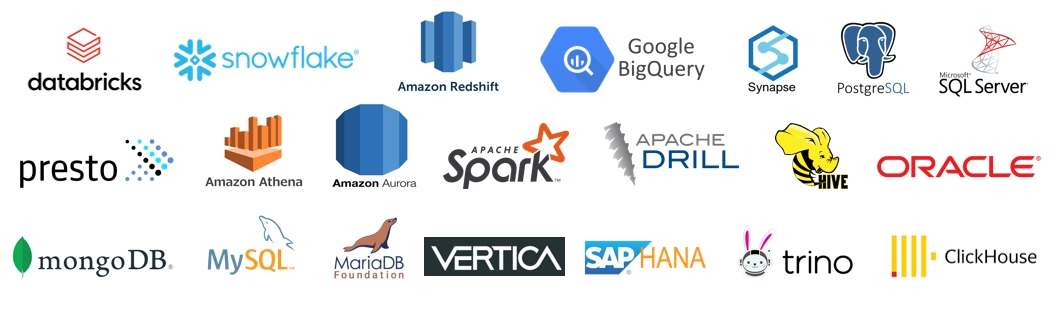
Connect to most clouds, datalakes, data warehouses, databases and many more file formats. Timbr empowers you to work with your data sources seamlessly.
Optimized Queries
How you store your data is up to you. By default, nothing is stored in Timbr. When a query is run, Timbr optimizes the query and pushes it down to the backend.
Model with Meaning and Relationships
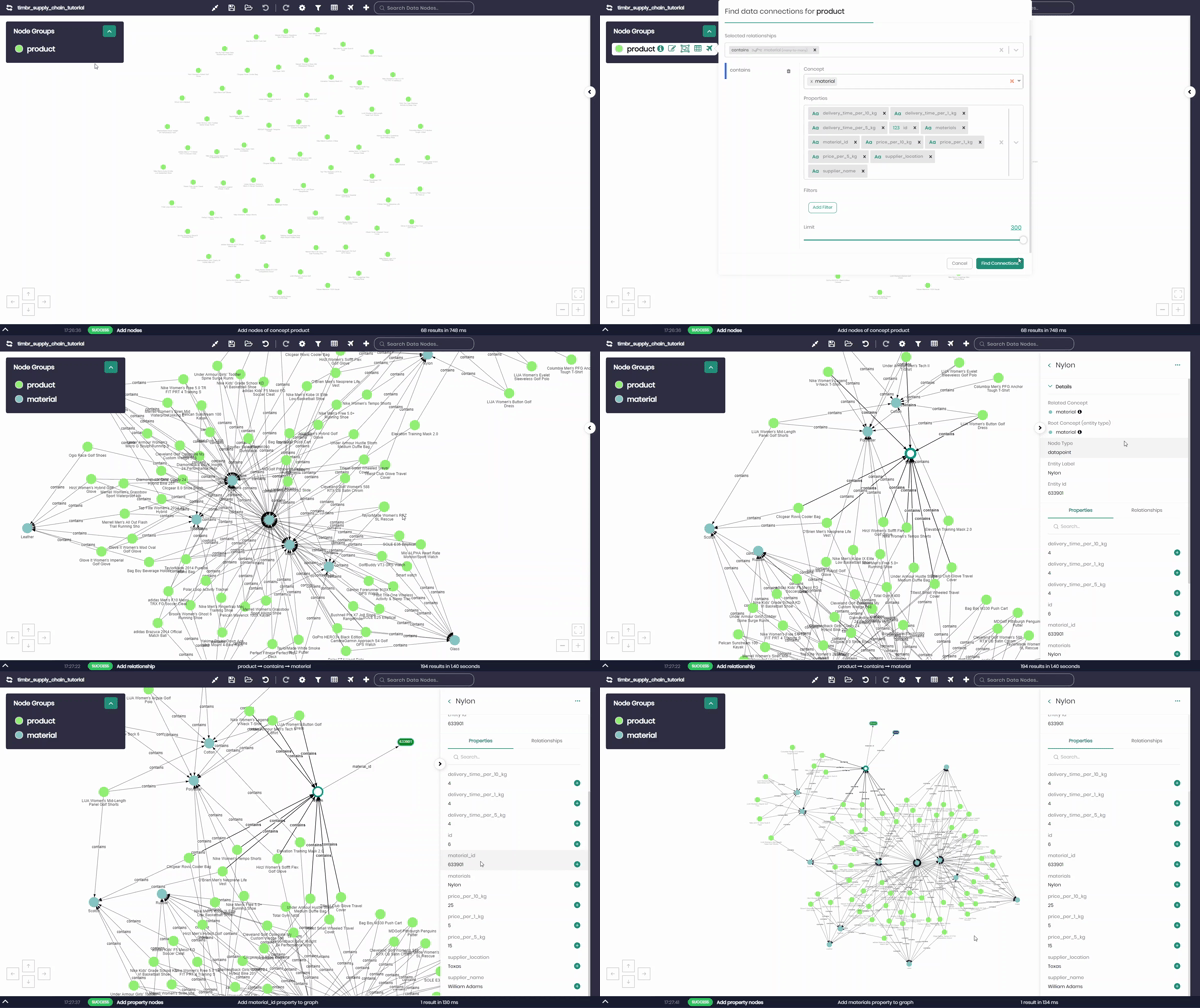
Organize data into real-world concepts with relationships and hierarchies that reflect your business logic.
Trusted and Common Metrics
Stop metric drift. Define KPIs once and make them reusable, explainable, and auditable.
Self-Service with Control
Enable business users to explore trusted data while enforcing governance policies.
Ready for AI Agents and LLM Accuracy
Provide structured, semantically-rich context that fuels retrieval-augmented generation and decision automation.
How Timbr Embeds into Databases
- Ontology Modeling: Timbr enables the creation of reusable semantic models that represent data as a connected semantic graph.
- Simplified Queries: By replacing complex SQL JOINs with explicit semantic relationships, Timbr simplifies querying across tables.
- Seamless Integration: Timbr can be consumed directly from your BI tools, through SQL clients, REST and GraphQL APIs, Jupyter notebooks, or natural language interface, ensuring flexible access for every user and application.
Features in Action
- Semantic Layer Integration: Transform structured, semi-structured, and unstructured data into a unified semantic graph for easy access and reuse.
- Metric Discovery: Automatically identify key metrics from data concepts and standardize them for advanced analysis in BI tools or SQL endpoints.
- Semantic Governance: Apply governance at the model level, control access, versioning, and data product usage.
Impact
- Enable Accurate LLM Access: Enable accurate LLM access to structured data.
- Accelerate Delivery of Data Products: Access meaningful insights faster with intuitive querying and reusable semantic relationships.
- Foster Collaboration: Enable teams to work with shared semantic models, improving alignment and decision-making.
- Scalable Efficiency: Leverage database capacity with Timbr’s semantic intelligence for robust, scalable workflows.