What Is a Semantic Layer?
Definition, architecture, and enterprise use cases
What Is a Semantic Layer?
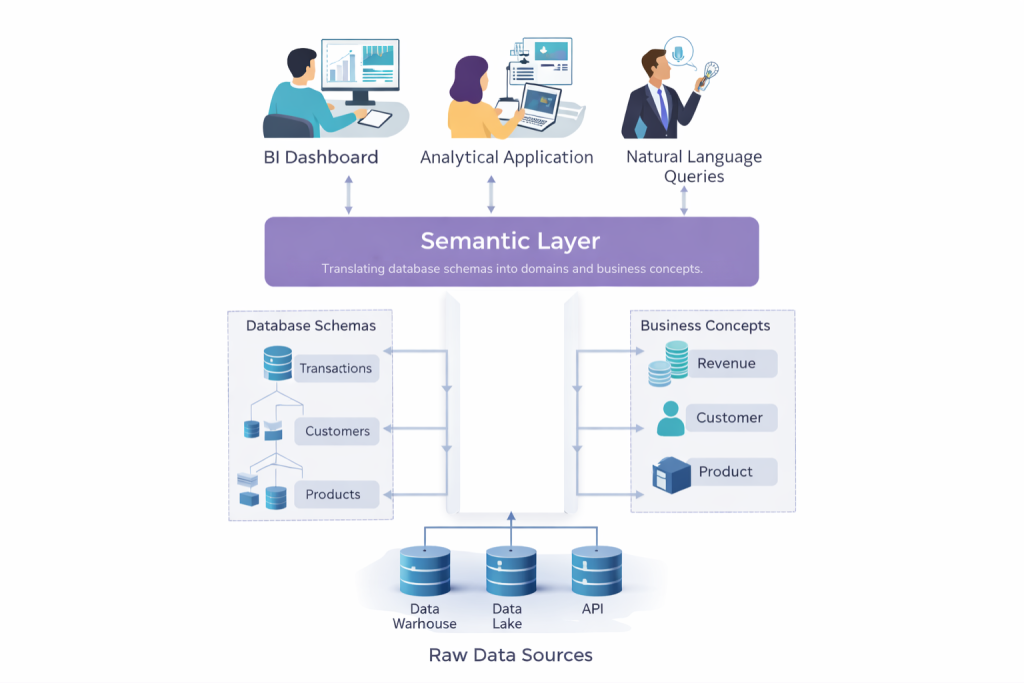
A semantic layer is an abstraction that sits between raw data sources and data consumers, translating physical schemas into business-oriented concepts and standardized logic. It defines metrics, dimensions, and relationships once, then exposes them consistently across reporting tools, dashboards, and analytical applications.
Instead of each analyst implementing their own definitions for metrics such as monthly recurring revenue or customer lifetime value, the semantic layer provides shared definitions that are reused across teams and tools. This reduces inconsistency, limits duplication of logic, and makes data more accessible to users who do not work directly with underlying schemas.
In practice, a semantic layer functions as both a translation mechanism and a control point for definitions and access. It hides technical complexity while enforcing a consistent interpretation of business concepts regardless of how or where data is consumed.
How a Semantic Layer Works
A semantic layer operates as an intermediary between users and underlying data systems. When a user builds a report or requests a metric, the semantic layer translates that request into executable queries, applies predefined business logic, and returns results without requiring the user to understand the physical structure of the data.
Business Modeling
The process begins with business modeling. The semantic layer defines entities such as customers, products, orders, and transactions, along with the attributes that describe them and the relationships that connect them across systems. These definitions reflect how the organization interprets its data, not how that data is physically stored.
Metric Definitions
On top of this model sits a metrics layer, where calculations such as revenue, churn, or average order value are defined explicitly. Each metric specifies aggregation rules, filters, and time behavior once, then reuses that logic across all consuming tools and workflows.
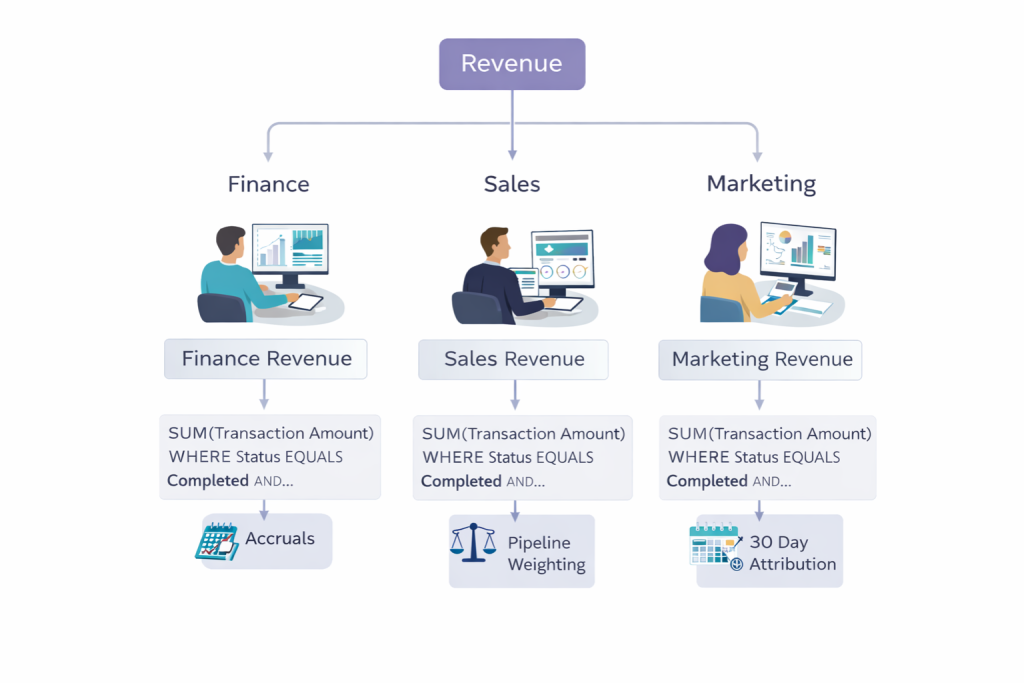
Consider how “Revenue” is typically defined. An organization might start with a simple calculation: the sum of all transaction amounts where the status equals ‘completed’. This definition works initially and gets encoded in the semantic layer.
Over time, however, different teams require variations. Finance adds accrual-based timing rules to recognize revenue when it is earned rather than when payment is received. Sales includes pipeline weighting to forecast expected revenue from opportunities not yet closed. Marketing applies attribution windows to assign revenue credit across multiple touchpoints over a 30-day period.
Each variation is defensible within its context, but they are no longer the same metric. The semantic layer attempts to unify these definitions by encoding conditional logic or creating metric variants. Without explicit constraints on what “Revenue” means and under what conditions each variant applies, the semantic layer accumulates overlapping definitions that produce different results depending on which tool or workflow accesses them.
This is where metrics begin to fragment, and the semantic layer’s role as a single source of truth starts to wear down.
Mapping to Physical Data
A mapping layer connects business concepts to physical data structures. It translates abstract definitions into the tables, joins, and transformations required to retrieve data from source systems. This layer is invisible to end users but essential for execution.
Query Translation and Governance
When a query is issued through a BI tool, dashboard, or API, a query translation engine applies the appropriate mappings and logic, generates SQL, and executes it against the underlying platform. Governance and access controls are enforced during this process, ensuring that users only see authorized metrics and data.
Together, these components create a governed interface to enterprise data that standardizes how information is defined, queried, and understood.
Common Semantic Layer Architectures
Semantic layers are implemented in different ways depending on organizational structure, tooling choices, and scope.
BI-Centric Semantic Layers
BI-centric semantic layers are embedded within analytics platforms such as Tableau, Power BI, or Looker. Definitions live inside the tool and work well when a single BI platform is dominant. They become limiting when multiple tools must share consistent semantics.
SQL-Based Views and Modeling Layers
SQL-based approaches encode business logic directly in database views or transformation frameworks. This keeps semantics close to the data and integrates well with existing governance processes, but maintaining consistency across many views becomes difficult as environments grow.
Metric Stores and Centralized Measures
Metric stores separate metric definitions from individual tools. Metrics are defined once and exposed through APIs or SQL interfaces, supporting reuse across analytical and operational workflows in multi-tool environments.
Headless Semantic Layers
Headless semantic layers act as dedicated abstraction services between data platforms and consumers. They define concepts and metrics independently of any specific tool and expose them through standard interfaces. This approach offers flexibility at the cost of additional infrastructure and operational complexity.
Each architecture reflects different tradeoffs between flexibility, governance, and maintainability.
What Semantic Layers Are Used For
Semantic layers address consistency and accessibility challenges that arise when many teams work with the same data across different tools.
They standardize core metrics so definitions are applied consistently across reports and dashboards. They enable self-service analytics by allowing users to work with validated concepts instead of raw schemas. They reduce duplication by centralizing business logic that would otherwise be reimplemented across tools. They also simplify complex queries by encoding joins and calculations once rather than embedding them in individual analyses.
As organizations adopt AI-driven analytics and natural language interfaces, semantic layers are increasingly used to provide structured context that automated systems require to generate correct queries and results.
Where Semantic Layers Work Well
Semantic layers are most effective in environments with relatively stable schemas, clearly defined metrics, and predictable analytical needs.
They perform well when business definitions are broadly shared and change infrequently, and when most data consumption occurs through standardized reports or dashboards. They are also well-suited to narrow analytical scopes, where a limited set of entities and metrics can be governed centrally without frequent conflict.
Under these conditions, semantic layers reduce duplication, improve consistency, and make data easier to work with across teams.
The Enterprise Reality
In production environments, semantic layers face challenges that are rarely visible in controlled deployments.
Enterprise data changes continuously. New systems are introduced, schemas evolve, and business rules shift. Each change requires updates to mappings and definitions, increasing maintenance overhead and risk.
As organizations grow, metric definitions diverge. Different teams require variations of the same concept, and without clear ownership and change processes, the semantic layer accumulates redundant or conflicting definitions.
Consider a mid-sized company with separate Finance, Sales, and Marketing teams, all using the same semantic layer to track customers. Finance defines “Active Customer” as anyone who has made a purchase in the last 90 days, based on transaction data. Sales defines it as anyone not marked as churned in the CRM system, which updates based on the account manager’s input. Marketing defines it as anyone who has engaged with an email or visited the website in the last six months.
All three teams use the term “Active Customer” in their reports and dashboards. All three believe they are working from a shared definition. When the CFO requests a consolidated view of active customers across the business, three different numbers appear. An emergency meeting is called. The investigation reveals that the semantic layer contains three separate metric definitions, all labeled similarly but implemented with different logic and different source tables.
The problem is not that any single definition is wrong. Each serves a legitimate business purpose within its domain. The problem is that the semantic layer allowed these definitions to coexist without surfacing the conflict, and without providing a mechanism to reconcile or govern them.
Semantic logic often drifts outside the layer itself. Analysts add calculations in dashboards, engineers encode logic in pipelines, and applications implement their own rules. Over time, the semantic layer no longer reflects how data is interpreted in practice.
Traditional semantic layers are also frequently limited to BI use cases, making reuse across operational systems, data science workflows, or AI applications difficult.
These pressures determine whether a semantic layer remains authoritative or gradually becomes bypassed.
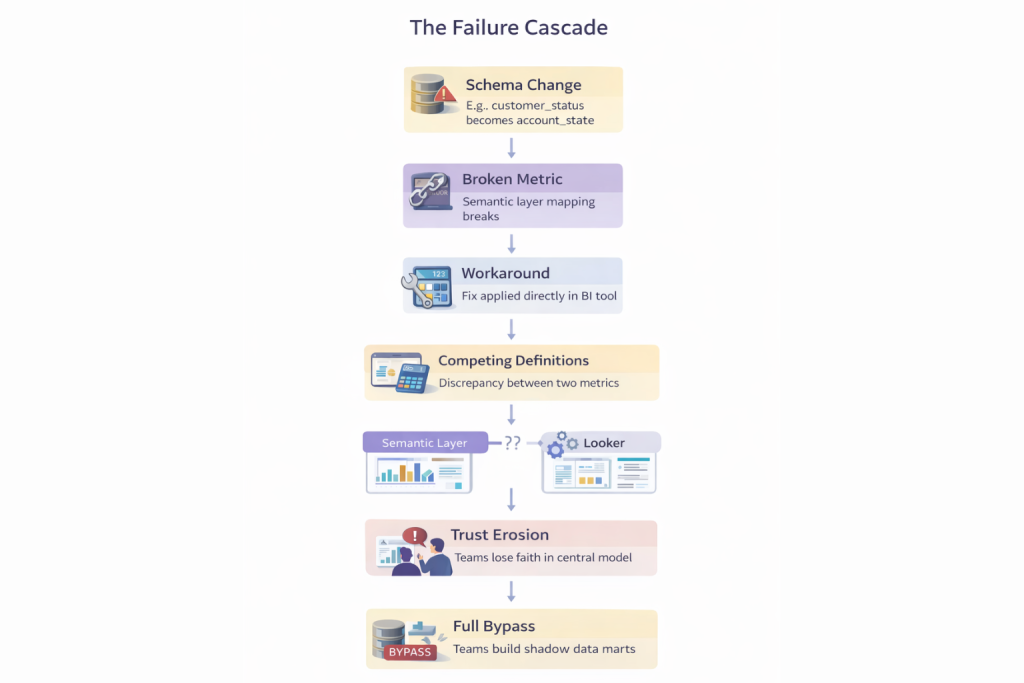
What Breaks in Production
Semantic layers rarely fail abruptly. They degrade incrementally.
In practice, degradation starts when definitions increase, mappings fall out of sync, and teams work around breakage in downstream tools.
The failure cascade follows a predictable pattern. A schema change occurs in a source system. A column is renamed from customer_status to account_state as part of a platform migration. The semantic layer’s mapping to the “Active Customers” metric breaks because it still references the old column name.
A dashboard that executives review daily begins returning errors. An analyst is pulled into an urgent fix. Rather than updating the semantic layer’s mapping, which requires formal change approval and affects multiple downstream reports, the analyst adds a calculated field directly in the BI tool to recreate the metric logic using the new column name.
The immediate problem is solved, but now two definitions of “Active Customers” exist. One lives in the semantic layer and uses the old schema reference. Another lives in a Looker calculated field and uses the new schema reference. Reports built on the semantic layer show one number. Dashboards using the calculated field show another.
Users notice the discrepancy. Trust in both the semantic layer and the reporting system declines. Teams begin building their own data marts with embedded logic, bypassing the semantic layer entirely to avoid future conflicts.
Within months, the semantic layer is technically operational but functionally irrelevant. It still exists in the architecture, but most active analytical work happens outside of it.
Why Semantic Layers Depend on Data Modeling
Semantic layers translate business concepts into executable queries. This translation depends on having a clear structure beneath it.
When relationships between concepts are implicit, name-based, or loosely documented, the semantic layer must reconstruct meaning at query time. This approach becomes fragile as complexity increases.
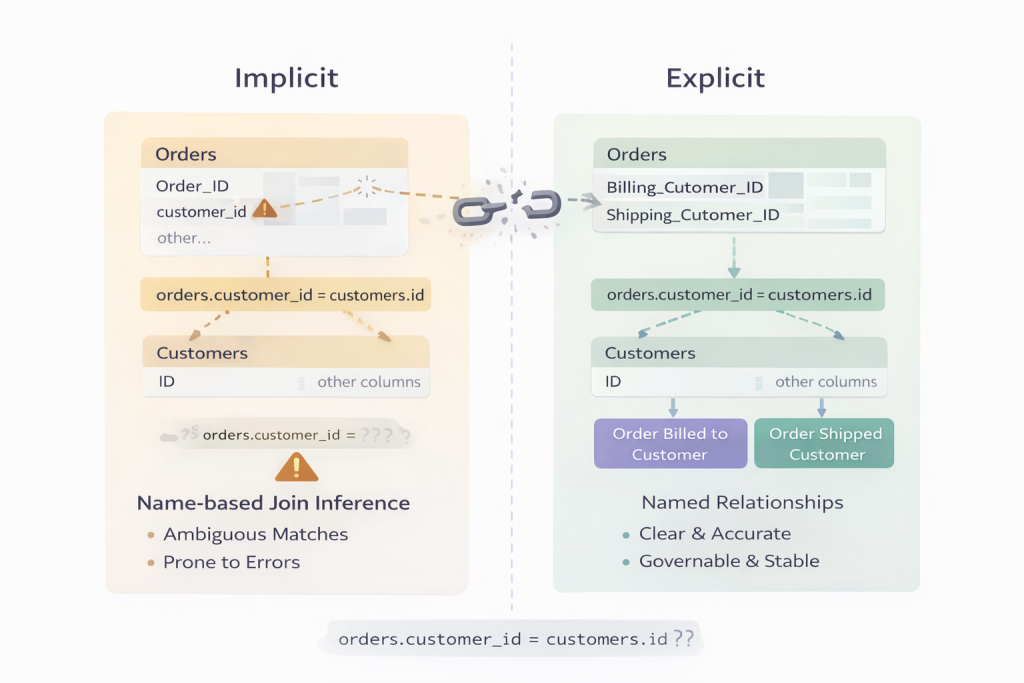
Consider how most semantic layers handle joins. An analyst defines a metric that requires combining customer and order data. The semantic layer infers the relationship between these tables by matching column names. It sees orders.customer_id and customers.id and assumes they represent the same entity, so it generates a join condition automatically.
This inference works until the schema introduces complexity. The organization begins tracking both billing customers and shipping customers. Two new columns appear: orders.billing_customer_id and orders.shipping_customer_id. Both reference the customers table, but they represent different relationships with different business meanings.
The semantic layer’s name-based inference can no longer determine which relationship is correct for a given query. It either defaults to one arbitrarily, producing incorrect results, or requires the analyst to specify the join manually, eliminating the abstraction that the semantic layer was meant to provide.
In contrast, an explicit relationship model defines “Order billed to Customer” and “Order shipped to Customer” as distinct, named relationships with specific semantics. The meaning is not inferred from column names. It is declared as part of the data model. When a query requests customer information in the context of an order, the semantic layer knows which relationship to apply because the relationship itself carries semantic intent.
This is the point where semantic layers begin to depend on more explicit structure. When concepts, relationships, and constraints are modeled directly rather than inferred, semantics become stable, reusable, and governable at scale.
Semantic Layers, Knowledge Graphs, and AI
Semantic layers have traditionally supported human-driven analytics. As AI systems increasingly generate queries, assemble context, and support decisions, the role of the semantic layer expands.
AI systems can generate syntactically correct SQL, but without explicit business semantics, they infer meaning from schemas that were not designed for interpretation. Semantic layers provide validated definitions that AI systems can rely on, improving accuracy and consistency.
When combined with knowledge graphs, semantic layers supply business-level abstractions that organize entities and relationships. Techniques such as GraphRAG rely on these definitions to assemble context based on validated connections rather than text similarity alone.
As AI use cases grow more complex, semantic layers designed only for reporting often lack the structural depth required. This reinforces the need for explicit, governed semantics that remain consistent across human and machine consumption.
Semantic Layers, Knowledge Graphs, and AI
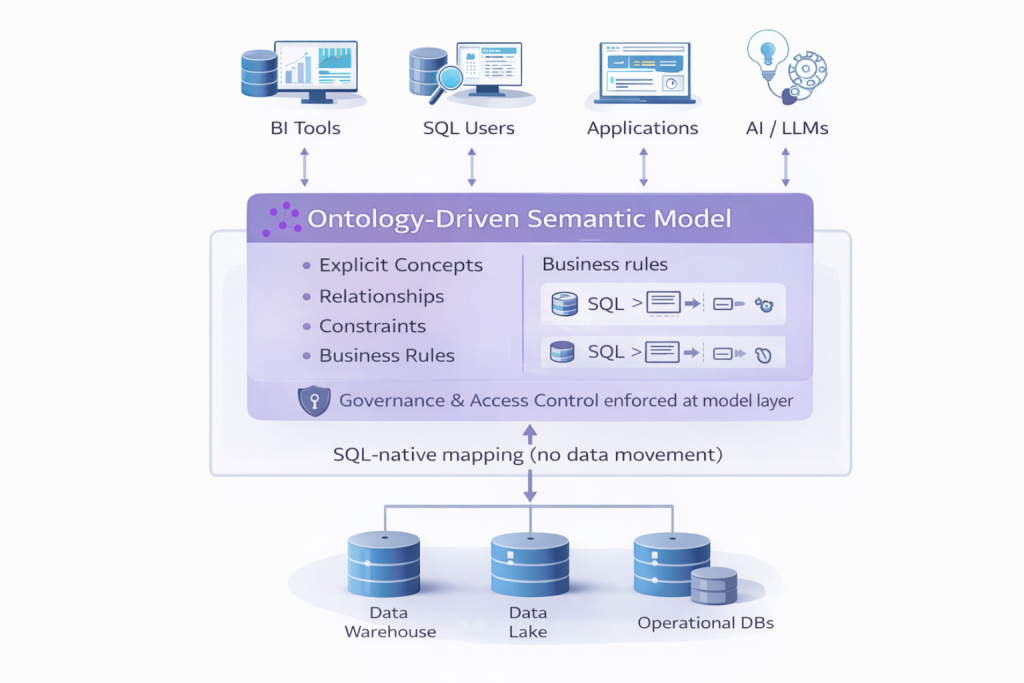
Timbr implements the semantic layer as an ontology-driven, SQL-native model that treats business concepts, relationships, and constraints as first-class elements.
Rather than inferring structure from schemas or relying on naming conventions, concepts are defined explicitly. A “Customer” is not a table that happens to be named customers. It is a defined concept with explicit attributes, relationships, and constraints that govern how it can be used and queried.
Relationships are not inferred from column names or foreign key constraints. They are declared as named relationships with declared intent. “Order placed by Customer” and “Order billed to Customer” are distinct relationships, each with defined cardinality, optionality, and business rules. This eliminates ambiguity at query time and prevents the kind of fragmentation that occurs when relationships are assumed rather than stated.
Semantics are expressed directly in SQL and mapped to existing data sources without requiring data migration. Business logic, access controls, and validation rules are embedded into the model itself rather than applied downstream in individual tools or queries. This means governance happens at the definition layer, not at the consumption layer, and remains consistent regardless of how or where data is accessed.
Because the semantic model is exposed through standard SQL interfaces, it can be reused across BI tools, analytical workflows, data science environments, and AI systems. The same definitions that power a dashboard also support a natural language query or a machine learning feature pipeline. Semantics do not need to be re-implemented or translated for each consuming system.
This approach prevents the drift and fragmentation that degrade traditional semantic layers. Definitions remain centralized and authoritative because they are enforced structurally, not procedurally. When a schema change occurs, mappings are updated once in the ontology, and consuming systems inherit the corrected definition through the same semantic interface.
Summary
A semantic layer abstracts physical data structures into business-oriented concepts and standardized logic, enabling consistent analytics and reporting across tools and teams. It is most effective in stable, reporting-centric environments with shared definitions and a narrow analytical scope.
In enterprise settings, semantic layers degrade when definitions fragment, mappings become brittle, and governance breaks down. These challenges intensify as organizations adopt AI systems that depend on explicit, structured context.
Understanding semantic layers as both translation mechanisms and governance challenges clarifies where they add value, where they introduce risk, and why explicit data modeling becomes essential as scale and complexity grow.
To see how ontology-based modeling keeps semantic definitions stable as systems evolve, learn more about Timbr’s ontology-driven semantic layer.