Snowflake Semantic Layer

USE CASE

Snowflake Semantic Layer

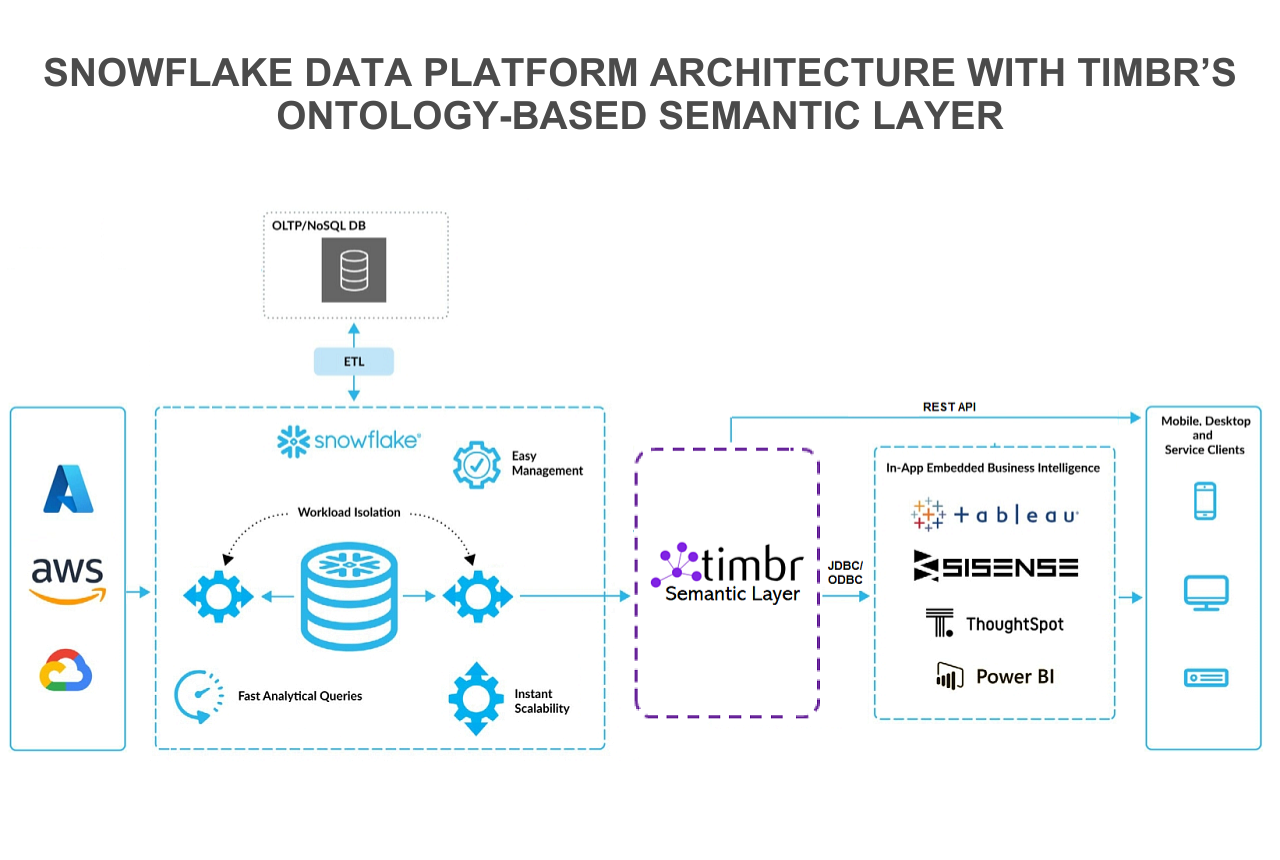
Timbr turns Snowflake into a semantic data platform by combining ontology-based modeling and relationships with Snowflake’s scalable analytics engine.

It sits directly on top of Snowflake, connecting BI tools, applications, and APIs to consistent business definitions while simplifying complex analytics and improving data discoverability.

REFERENCE ARCHITECTURES

Timbr embeds a semantic layer within Snowflake architectures, creating a unified environment connecting BI tools, applications, and APIs to consistent business definitions.

BEHIND THE USE CASE

Timbr and Snowflake together enable scalable semantic data models that simplify complex analytics and help teams share trusted business definitions consistently across the organization.

SNOWFLAKE INTEGRATION

Timbr connects directly to Snowflake to create a governed semantic layer that simplifies analytics workflows and improves data discovery for teams across the entire organization.

AI DATA RETRIEVAL

Combine Snowflake data with unstructured information to power AI applications that deliver accurate, context-aware insights using GraphRAG workflows across enterprise data sources.
Challenges

Are Metrics Fragmenting Across Your Snowflake Environment?
Snowflake scales analytics effortlessly, but it does not govern what data means. As usage grows, teams write SQL independently, reuse datasets in different ways, and build dashboards with conflicting logic. The result is different teams defining the same business concept differently, leading to confusion, duplicated work, and slower decisions.
Is Business Logic Getting Lost Between the Data and the Query?
Relationships between datasets in Snowflake are reconstructed every time analysts write a query. Analysts navigate joins manually, embed business logic in SQL scripts, and rely on institutional knowledge that lives in individual notebooks rather than a shared model. This complexity grows with every new team, tool, and data source added to the platform.
Is Your Snowflake Data Ready for AI?
When LLMs and AI agents attempt to generate SQL or answer business questions from Snowflake, they encounter the same ambiguity as human analysts. Without explicit relationships and governed definitions, they guess at joins and metrics, producing results that may look reasonable but are difficult to trust at scale.

Why Timbr

One Semantic Model, Defined Once and Reused Everywhere
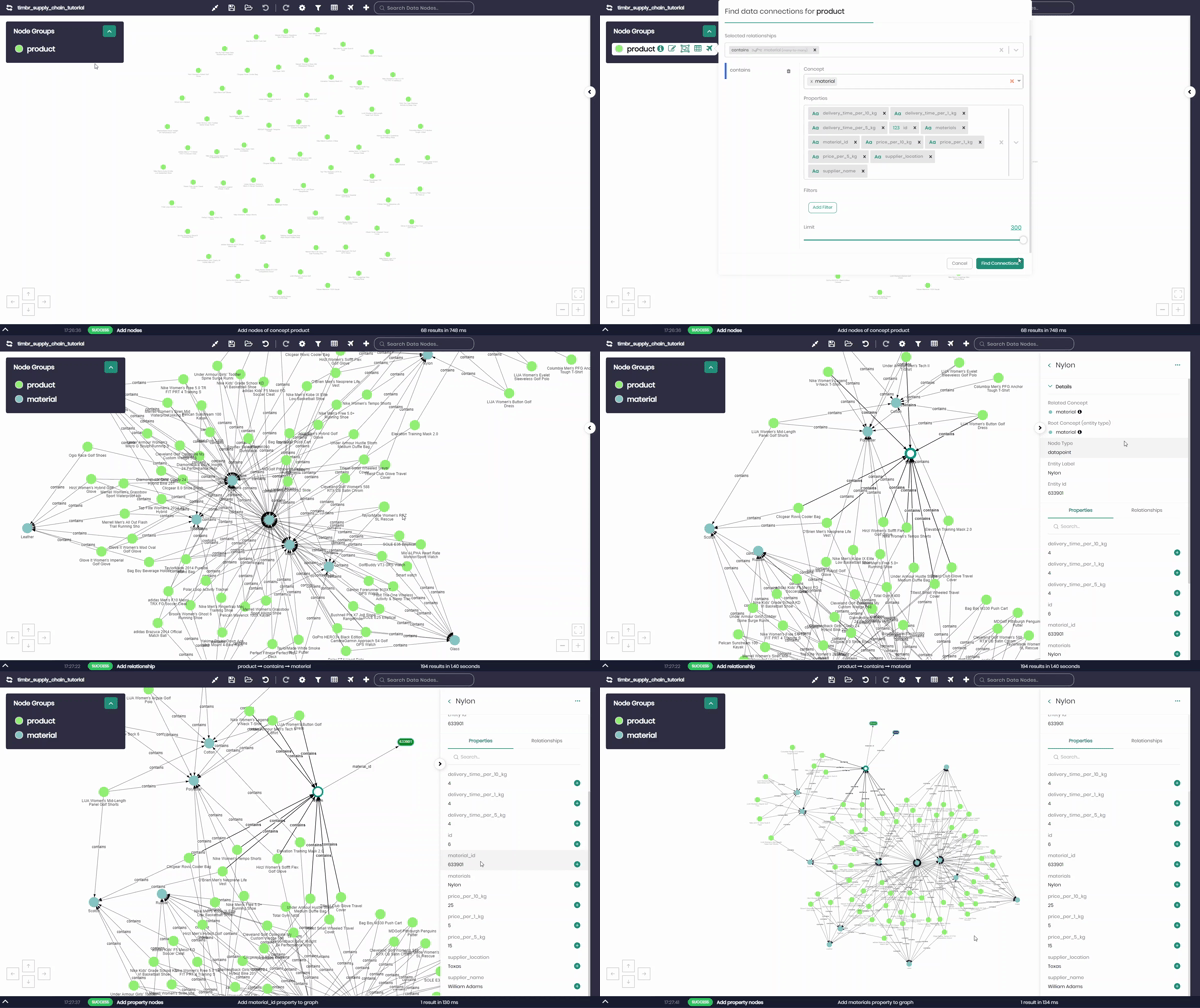
Timbr sits directly on top of Snowflake as an ontology-based semantic layer, modeling data as connected business concepts with explicit relationships, metrics, and business rules. Every BI tool, application, and AI workflow connected to Snowflake draws from the same governed model, eliminating conflicting definitions at the source.
Relationships Without Joins
Instead of reconstructing relationships in every query, Timbr defines them once in the ontology. Analysts write SQL against business concepts rather than raw tables, and Timbr handles the underlying logic. Queries that previously required dozens of lines can be expressed in a fraction of that, without sacrificing accuracy or control.
A Structured Foundation for AI on Snowflake
Timbr gives LLMs and AI agents a relationship-aware, governed view of Snowflake data. This enables accurate NL2SQL, reliable structured retrieval, and AI-driven analytics that return consistent results, because the data they are querying is already modeled as explicit business concepts with defined connections.

Impact

Consistent Metrics Across Every Team and Tool
Business logic defined once in the semantic layer means every dashboard, application, and AI query draws from the same trusted definitions. Metric discrepancies are resolved at the model level, not debugged query by query.
Faster, Simpler Analytics Development
Data teams spend less time writing and maintaining complex SQL and more time delivering insights. Shared ontology models reduce duplication across projects and make onboarding new analysts significantly faster.
Snowflake Data That Is Ready for AI
As organizations expand into Cortex, LLM agents, and AI-driven reporting, Timbr ensures those workloads are anchored to governed business concepts, producing results that are accurate, consistent, and explainable across every use case.

Timbr Product Overview

Partner programs enquiry

The information you provide will be used in accordance with the terms of our

privacy policy.

Schedule Meeting

Model a Timbr SQL Knowledge Graph in just a few minutes and learn how easy it is to explore and query your data with the semantic graph

Model a Timbr SQL Knowledge Graph in just a few minutes and learn how easy it is to explore and query your data with the semantic graph

Register to try for free

The information you provide will be used in accordance with the terms of our privacy policy.

Talk to an Expert

Your PDF Is On Its Way!

We’ve emailed the PDF to the address you provided.

If you don’t see it in a couple of minutes, please check your Promotions or Spam folder.

Thank You!

Our team has received your inquiry and will follow up with you shortly.

In the meantime, we invite you to watch demo and presentation videos of Timbr in our Youtube channel: