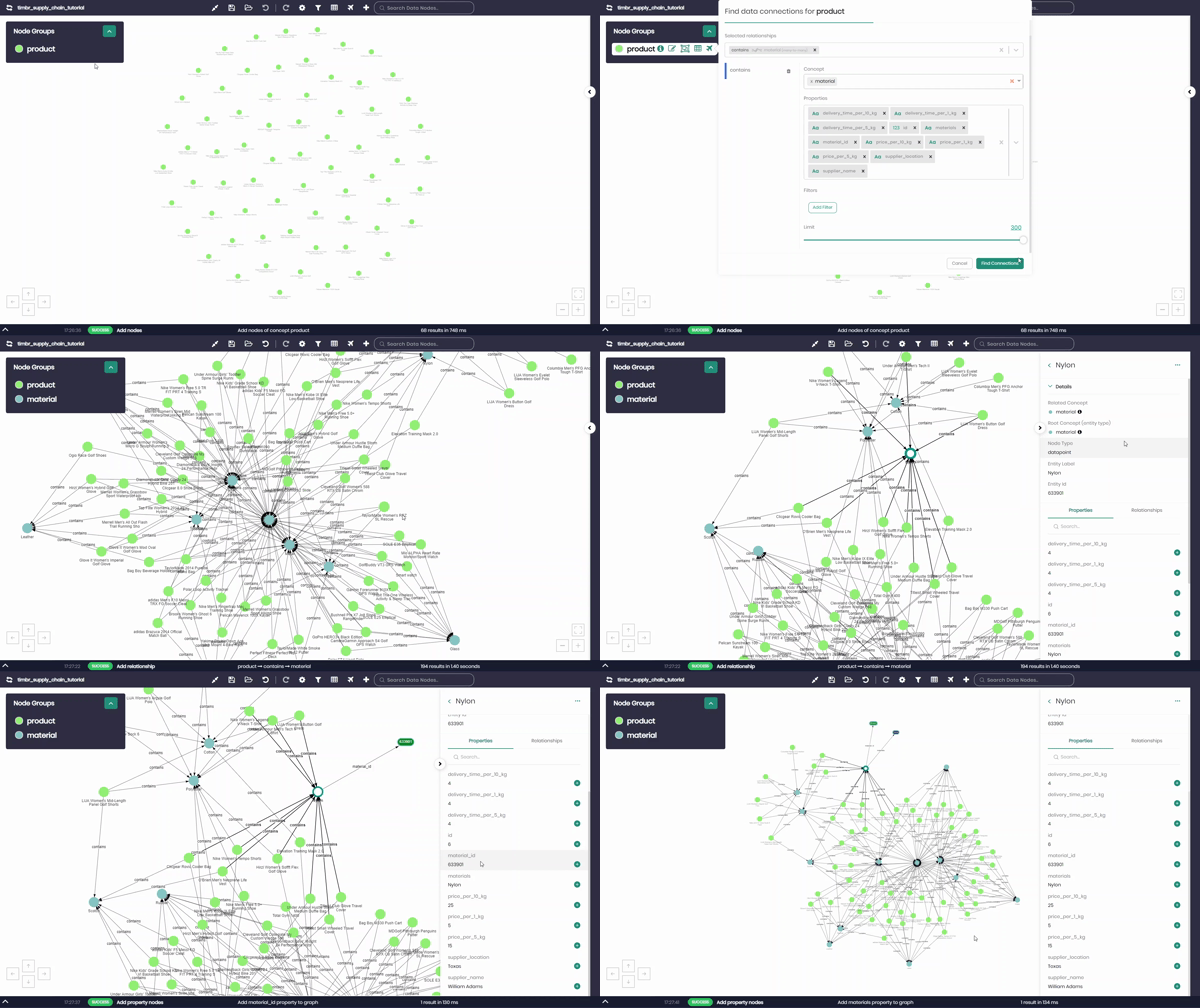

- Snowflake scales analytics effortlessly, but as usage grows, business meaning often fragments across teams, tools, and SQL.
- Ontology-based semantics bring shared definitions, relationships, and metrics directly into Snowflake without changing how data is stored or queried.
- This semantic foundation enables consistent analytics today and reliable AI-powered insights, including NL2SQL and agent-driven workflows, at scale.
Snowflake has become one of the leading platforms for enterprise analytics by combining cloud-native storage, scalable compute, and strong performance into a fully managed data platform. Its separation of compute and storage allows organizations to scale with demand and move quickly without being slowed by infrastructure concerns.
But this ease of access and scalability hides a challenge that many organizations only notice once usage grows beyond a small analytics team. Snowflake reliably processes queries, but it does not govern what the data means. Teams write SQL independently, reuse datasets in different ways, and build dashboards with conflicting logic. The result is not a system failure, but semantic drift, where different teams define the same business concept differently. Over time, this leads to confusion, duplicated work, and slower decision making.
This challenge becomes more visible as organizations introduce AI-powered analytics and natural language query interfaces. When LLMs attempt to generate SQL or answer business questions automatically, they encounter the same ambiguity as human analysts. Without explicit definitions and relationships, they guess at joins and metrics, producing results that may look reasonable but are difficult to trust.
This is not a flaw in Snowflake’s architecture. It is the natural result of modern analytics at scale, where access to data grows faster than shared meaning. What is missing is a foundation of business logic that sits above the warehouse, remains usable within it, and provides consistent interpretation across teams and tools. That is where a semantic layer defined around business concepts, and specifically an ontology-based semantic layer, plays a critical role.
The Power of Snowflake (and What It Does Not Solve)
Snowflake’s strengths are well known. It provides a cloud data platform that unifies storage, processing, and analytics across clouds without the operational burden of managing infrastructure. Its architecture delivers elastic compute, high concurrency, and a consistent SQL experience across analytics, data engineering, and machine learning workloads.
Snowflake executes logic extremely well. Its virtual warehouses scale on demand, and its governance tools give administrators strong control over access and security. These capabilities make Snowflake a trusted execution layer for enterprise analytics.
However, Snowflake does not centralize business meaning. In practice, business metrics, transformations, and relationships are defined in views, dashboards, or SQL scripts scattered across teams and projects. This decentralization works early on, but it becomes fragile as analysts, engineers, applications, and AI systems multiply. Over time, teams query the same data while relying on different interpretations of what that data represents.
Snowflake’s Native Semantic Capabilities
Snowflake has recognized this challenge and introduced semantic views as a native schema-level object. Semantic views allow teams to define metrics, dimensions, and logical relationships directly inside the platform, helping reduce duplication and improve consistency across SQL queries and BI tools.
Semantic views provide a solid foundation for metric governance within Snowflake. They allow teams to define standardized logic, establish relationships between tables, and integrate semantic definitions with Snowflake’s existing security and governance model. This represents meaningful progress toward more consistent analytics.
At the same time, semantic views address a specific layer of the semantic problem. They are schema-level objects designed to support Snowflake’s query engine and typically require manual modeling per use case. As organizations grow, they often need semantics that span multiple domains, tools, and consumption patterns. Supporting that level of reuse and coordination generally requires an additional abstraction layer beyond individual schemas.
Where Meaning Breaks Down as Snowflake Usage Grows
In small teams, it is relatively easy to agree on what a metric means. Terms like customer lifetime value or total revenue may have a single accepted definition. As organizations scale across finance, product, operations, and marketing, those definitions start to diverge.
In Snowflake environments, this fragmentation commonly appears in a few ways.
Duplicated logic in views and dashboards
Teams define the same metric with slightly different SQL, embedding business logic deep inside views or BI configurations. When definitions change, updates are required in multiple places, and inconsistencies creep in.
Metrics fragmented by tools
Each BI tool or analytics interface represents logic differently. Without a shared semantic foundation, teams reimplement metrics across tools or rely on documentation that quickly becomes outdated. AI-powered copilots face the same problem when trying to translate business questions into SQL.
Joins and relationships buried in SQL
Relationships between entities such as customers and orders exist only as repeated JOIN clauses inside queries. This makes it hard to reason about intent or ensure consistency. For LLMs attempting NL2SQL translation, this is where join hallucinations occur, when the model guesses at relationships and produces syntactically valid but semantically incorrect queries.
Governance focused on objects, not meaning
Snowflake governs access to tables, schemas, and views, but business semantics remain implicit. Even with semantic views, coordination across teams is required to maintain consistent meaning.
As these issues compound, trust erodes. Executives question why dashboards disagree. Analysts spend time reconciling definitions. New team members struggle to identify which query reflects the real metric.
What a Semantic Layer Adds on Top of Snowflake
A semantic layer is a structured representation of business meaning that sits above database objects and below consumption interfaces such as dashboards, analytics applications, or AI-driven tools. It does not replace Snowflake. It augments it by centralizing definitions, relationships, and logic that would otherwise be scattered across SQL and tooling.
At a high level, a semantic layer:
Defines business concepts explicitly
Concepts like monthly recurring revenue or active customer are defined once, with governed logic and clear ownership.
Standardizes metrics and dimensions
Everyone references the same definitions, regardless of which tool or interface they use.
Connects entities through relationships
Relationships between customers, orders, and products are modeled explicitly rather than repeatedly expressed in SQL joins.
Supports multiple consumers
BI tools, notebooks, SQL users, and automated systems all query the same semantic model.
This layer does not interfere with Snowflake’s execution capabilities. Snowflake continues to handle query performance and scale, while the semantic layer ensures that queries reflect consistent business meaning.
Not all semantic layers are built the same. The key difference lies in how business logic and relationships are modeled.
Why Ontology-Based Modeling Fits Snowflake's Model
An ontology-based semantic layer models both entities and relationships explicitly, creating a structured representation of business meaning that mirrors how organizations actually think about their data.
This approach is especially relevant for AI-powered analytics. LLMs are trained on SQL, not proprietary query languages or graph databases. An ontology-based semantic layer built in SQL provides the structure LLMs need to generate accurate queries because it aligns with how they were trained.
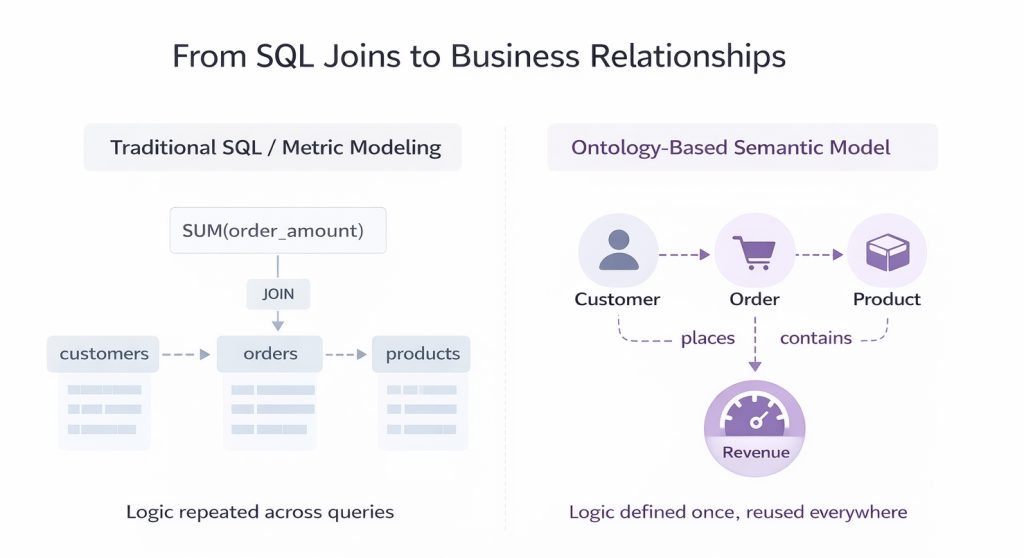
In an ontology-based model:
Business concepts are entities with attributes and relationships
A customer is not just a table or a metric. It is an entity with properties and relationships to accounts, products, and transactions.
Relationships are first-class
Instead of repeating JOIN logic across queries, relationships are defined once and reused consistently. This eliminates join hallucinations in AI-generated SQL because relationships are explicit rather than inferred.
Metrics are expressed in terms of entities and relationships
Revenue becomes a calculation grounded in transactions, customers, and time, making it easier to audit, reuse, and explain.
Because ontology-based models map directly to relational structures, they align naturally with SQL-based systems like Snowflake. They can be implemented without moving data or duplicating storage, while still providing a richer semantic foundation.
What You Can Do With This
Once semantics are centralized in an ontology-based model, the impact is tangible.
Consistent metrics across tools
Analysts using different BI platforms or SQL interfaces rely on the same definitions.
Faster onboarding
New team members work with meaningful business concepts immediately instead of reverse engineering logic from queries.
More trustworthy automated insights
Systems that generate or assist with SQL operate against governed definitions and relationships, improving reliability and explainability.
These outcomes translate into higher confidence, less rework, and faster decision cycles.
Timbr as an Example of Ontology-Based Semantics on Snowflake
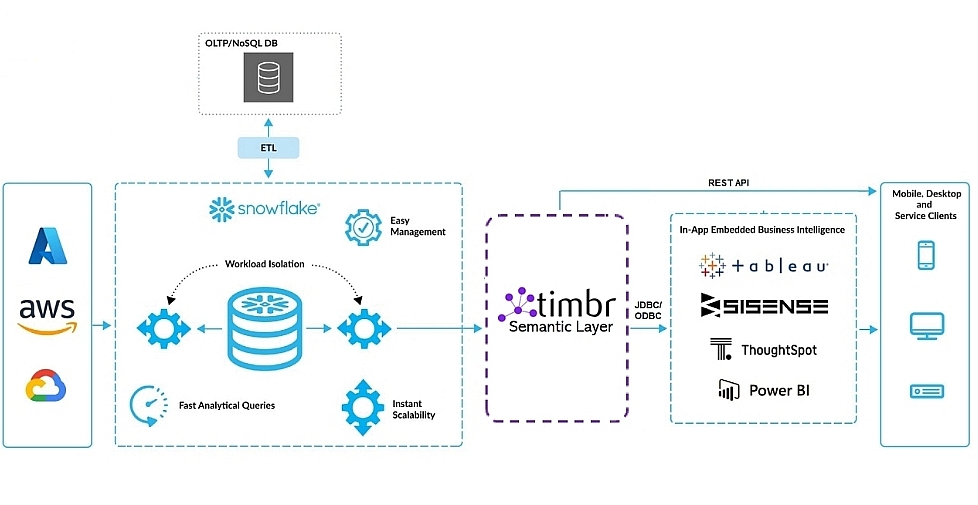
Timbr implements an ontology-based semantic layer designed specifically for Snowflake environments and optimized for AI workloads. It models business concepts and relationships as SQL-native constructs that map directly to Snowflake tables and views. Business logic lives alongside Snowflake data, not outside it.
The workflow is straightforward. Define the business ontology once, including entities such as customers, products, and orders, along with their relationships. Map those concepts to Snowflake objects. From there, analysts, BI tools, and AI systems query the same governed semantic model using standard SQL.
This approach keeps the semantic layer lightweight. There is no data movement and no separate store to synchronize. Snowflake handles execution and performance, while Timbr provides a shared, governed understanding of business meaning.
Because the semantic model is SQL-native, it serves both human analysts and AI systems reliably. LLMs and agents use the ontology to generate accurate SQL for NL2SQL workflows, following explicit relationships instead of guessing at join patterns. This allows AI-driven analytics to move from experimentation to production, with results that are explainable, auditable, and governed by the same rules as human analysis.
Why This Matters Now
Snowflake has earned its place as a core platform for enterprise analytics. As organizations rely more heavily on data for AI-driven decision making, the challenge shifts from running queries to agreeing on what those queries mean and ensuring AI systems can generate reliable, AI-powered insights that can be trusted.
Without a shared semantic foundation, organizations pay a tax in time, trust, and duplicated effort. Ontology-based semantic modeling does not replace Snowflake or its native capabilities. It complements them by providing a reusable layer of business meaning that works across teams, tools, and AI-powered consumption patterns.
For organizations building analytics on Snowflake and struggling with metric consistency, onboarding complexity, or reliable AI-powered insights, an ontology-based semantic layer may be the missing piece.
Learn more about ontology-based semantic layers on Snowflake, or contact us to see how Timbr brings governed semantics and AI-ready structure to Snowflake environments.