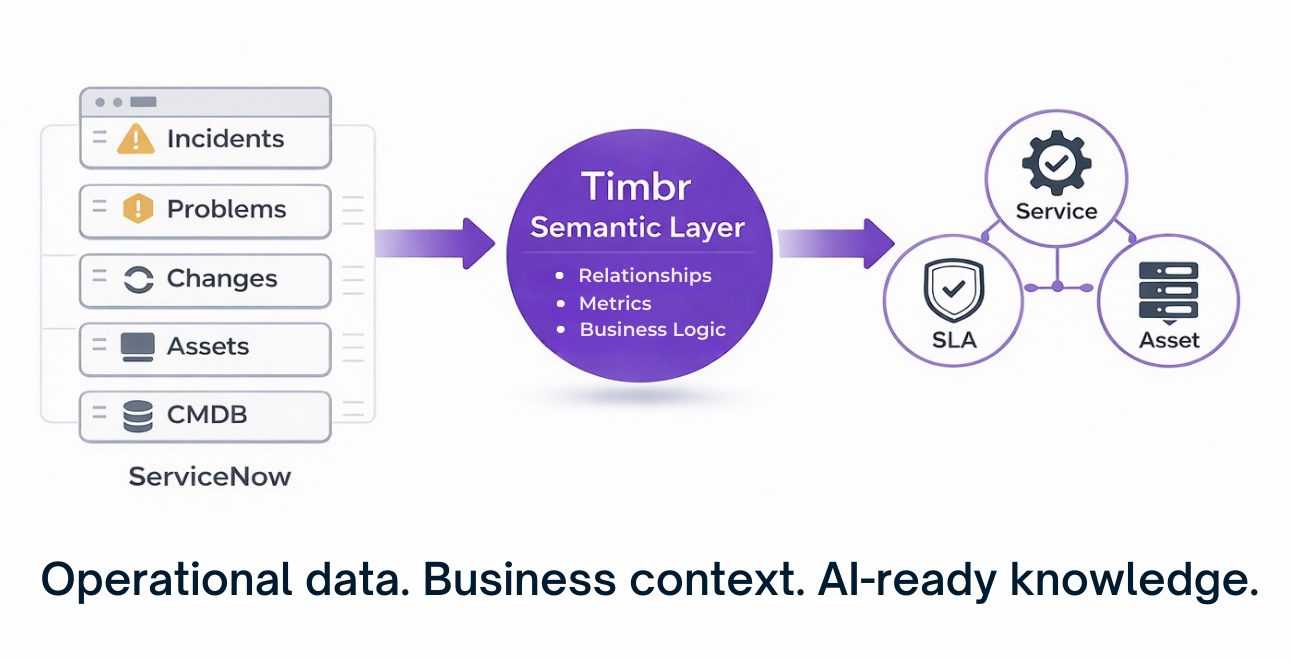
- ServiceNow knows everything about your IT operations. Your analytics tools know almost none of it. ServiceNow’s deeply relational data is still queried by most teams as a collection of flat tables.
- Timbr connects to ServiceNow as a native data source and automatically generates an ontology-based semantic layer. Incidents, assets, services, SLAs, and configuration items become governed business concepts with explicit relationships.
- As AI agents take on more operational responsibilities, Timbr provides the structured foundation they need to reason accurately about incidents, dependencies, and service impact.
Introduction
Ask any IT operations leader what they wish their data could tell them, and the list is long. Which services are most vulnerable right now? Which configuration items are involved in the most recurring incidents? Where are the dependencies that turn a minor change into a major outage? The answers to these questions are almost always already in ServiceNow. The challenge is extracting them in a form that is accurate, consistent, and usable across teams, tools, and AI systems.
ServiceNow is one of the most data-rich platforms in the enterprise. It captures incidents, problems, changes, assets, services, SLAs, configuration items, and the relationships between them. That relational structure is the foundation of how ServiceNow manages IT operations.
However, when organizations analyze ServiceNow data outside the platform, that structure is rarely preserved. Data is exported as flat tables. Queries reconstruct relationships manually. Dashboards report on isolated records instead of connected operational context.
Timbr addresses this gap by turning ServiceNow operational data into a governed semantic model that can be consumed consistently across analytics platforms, applications, and AI systems.
The Intelligence Inside ServiceNow Data
ServiceNow was designed around relationships.
Incidents connect to services. Services depend on configuration items. Assets belong to vendors and owners. SLAs define performance expectations for the services the business depends on.
The Configuration Management Database illustrates this clearly. A CMDB is a model of relationships between infrastructure, software, services, and business capabilities. Impact analysis and change risk assessment rely on understanding how those relationships interact.
When ServiceNow data moves into analytics environments, teams must manually reconstruct those relationships. Incident records must be joined to services, configuration items must be traced through the CMDB, and SLA definitions must be reimplemented in reporting logic. Each team ends up rebuilding the same operational model in its own queries.
This is not a limitation of ServiceNow. It is the result of consuming a relational operational system without a shared semantic model.
What Breaks Without Semantic Modeling
The symptoms are familiar to teams that attempt serious analytics on ServiceNow data.
Operational metrics diverge across teams. One team measures mean time to resolution from ticket creation. Another measures it from first assignment. Both queries run successfully, yet the results differ because the logic lives inside individual SQL scripts instead of a shared model.
Queries that should be straightforward become engineering exercises. A question about which services experienced repeated high-severity incidents might require navigating multiple tables, priority hierarchies, service relationships, and SLA definitions. Each query encodes business logic that must be rewritten and maintained over time.
Enterprise context disappears when ServiceNow data is separated from the rest of the business environment. Services in ServiceNow correspond to revenue-generating products, customer contracts, and risk exposure. Assets belong to departments with budgets and owners. Without a semantic layer connecting these domains, analytics tools and AI systems cannot see the full operational picture.
The data itself remains correct. What is missing is a shared structure that captures its meaning.
ServiceNow as a Native Data Source in Timbr
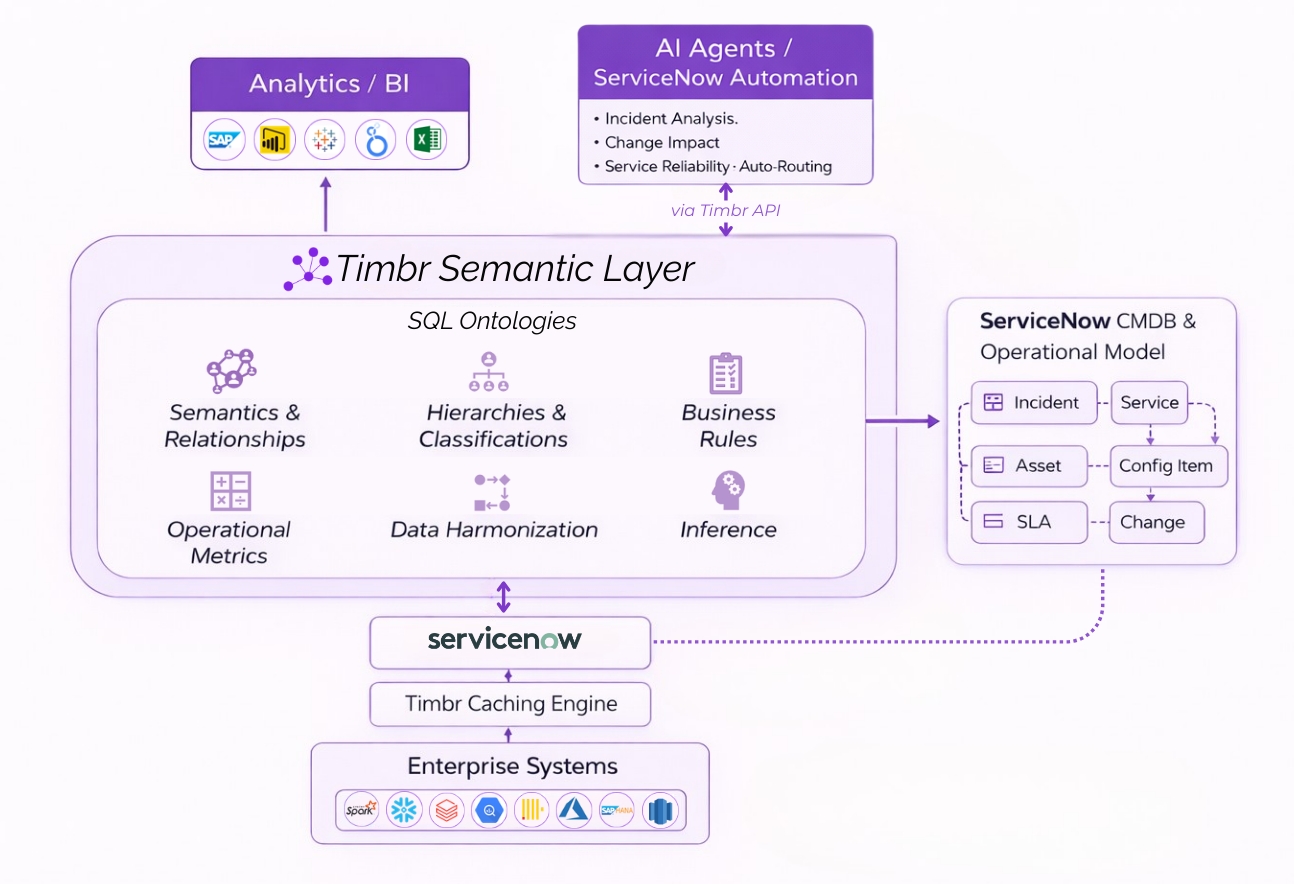
Timbr connects to ServiceNow as a native data source and automatically generates a semantic ontology from the ServiceNow schema. Incidents, services, assets, configuration items, SLAs, and related entities become business concepts within the ontology. Each concept includes properties, governed metrics, and explicit relationships that describe how the operational environment actually works.
Instead of navigating raw tables, analysts and systems query these business concepts directly. The relationship between an incident and the service it affects is defined once in the ontology and reused everywhere. Timbr handles the SQL translation required to retrieve the correct data from ServiceNow while preserving the meaning defined in the model.
Because Timbr is SQL-native, organizations do not need to move data or maintain a separate storage system. ServiceNow remains the system of record. Timbr operates as a virtual semantic layer that exposes governed operational knowledge to analytics tools, applications, APIs, and AI systems.
This approach allows organizations to keep their operational data in ServiceNow while making that data usable across the broader enterprise data ecosystem.
Consistent Operational Metrics Across the Organization
A semantic model also centralizes the logic behind operational metrics.
Metrics such as mean time to resolution, incident recurrence, SLA compliance, and service reliability are often implemented separately across dashboards and analytics scripts. Over time, these definitions diverge. Reports begin to conflict. Teams spend more time debating numbers than interpreting them.
Timbr resolves this by defining metrics and business rules once within the ontology. Every query, dashboard, and application references the same definitions. When a metric changes, the update occurs at the model level rather than inside dozens of queries.
This ensures operational analytics remain consistent as the ServiceNow environment evolves.
A Structured Foundation for ServiceNow AI Agents
ServiceNow is rapidly expanding its use of AI-driven automation. Intelligent triage, automated incident routing, virtual service agents, and change risk analysis increasingly rely on AI systems to interpret operational data and recommend actions.
The effectiveness of those systems depends on the structure of the data they query.
An AI agent tasked with evaluating the impact of a change must understand which services depend on affected configuration items, which teams own those services, and what SLA commitments are at risk. Without explicit relationships, the agent attempts to infer these connections from table structures and query patterns.
The query may run successfully. The answer may appear reasonable. Yet the agent is guessing at the meaning of the data rather than reasoning over a defined model.
Timbr provides AI agents with a relationship-aware view of ServiceNow data. The ontology reflects the structure of the business environment rather than the structure of database tables. AI systems query the semantic layer instead of raw schemas, ensuring the results align with how the organization actually defines its services, assets, and operational processes.
Customers are already accessing Timbr from within ServiceNow via API to power these kinds of agentic workflows. This enables more reliable use cases such as automated incident analysis, service dependency exploration, and AI-assisted operational decision-making.
One Semantic Model for Analytics and AI
The same Timbr ontology that supports analytics also supports AI systems.
Business logic does not need to be defined separately for dashboards and for agents. The ontology becomes the shared model that every consumer uses. BI tools, SQL clients, APIs, analytics platforms, and AI workflows all access the same governed representation of ServiceNow data.
As organizations expand their use of automation and AI-driven IT operations, this shared semantic foundation becomes increasingly valuable. New applications inherit the same consistent understanding of operational relationships without rebuilding the logic themselves.
Conclusion
ServiceNow already contains the operational intelligence enterprises rely on to run their technology environments. Incidents, services, dependencies, SLAs, configuration items, and assets describe how systems function across the organization.
What is often missing is the semantic structure that makes that intelligence accessible across teams and technologies.
Timbr provides that structure. By transforming ServiceNow schemas into an ontology of connected business concepts, organizations can expose governed operational knowledge to analytics tools, applications, and AI agents through a single semantic layer.
The data has always been there. Timbr is what turns it into enterprise intelligence.
See how Timbr brings semantic structure to ServiceNow data. Request a live demo to explore the architecture and capabilities in action.